SEOW
SEOW
The SEOW brings together representatives from various traditional behavioral health partners and non-traditional prevention-focused sectors to share data and expertise. While the group’s original intent was to focus on substance use prevention and behavioral health, its focus has grown over time to include the role that health disparities and health equity play in behavioral health.

Our Mission
The Virginia State Epidemiological Outcomes Workgroup (SEOW) is an action-oriented group that brings together data partners across the commonwealth to:
Additional information and historical reports from the SEOW are available at vasis.org/reports-other-documents.
PURPOSE
The purpose of the SEOW is to coordinate among agencies to leverage collective expertise, share data, and ensure members, their organizations, and the broader community use best practices for data.
PRINCIPLES
Three principles guide the SEOW:
Accessibility — The SEOW values the usability of data, ensuring it is accessible and comprehensible for community partners and Virginia residents.
Ethical and Equitable Practices — The SEOW is committed to ethical and equitable data sharing and usage. When the SEOW utilizes and shares data, it includes context, limitations, and the intended use of the data.
Impactful Delivery — The SEOW prioritizes delivering data in a way that makes an impact. The delivery is actionable and supports informed, data-driven decisions.
PRACTICES
Developed from the purpose and principles of the group, the SEOW adheres to the following practices:
Ensure data shared and utilized within the group is available and valuable to the public.
Guide how to appropriately disseminate and share data, including criteria, timelines, and limitations for SEOW members and the larger community.
Develop distribution plans to ensure dashboards and data are reaching the identified audience in an equitable and accessible way.
The Year in Review
Membership
Members actively supporting SEOW efforts in 2026 included representatives from the following organizations:
View All Member Organizations
- Collective Health Impact, LLC
- Colonial Behavioral Health Community Services Board
- Falls Run Community Association
- Northwestern Community Services Board
- Virginia Alcoholic Beverage Control Authority
- Virginia Cannabis Control Authority
- Virginia Beach Community Services Board
- Virginia Department of Behavioral Health and Development Services
- Problem Gambling Treatment and Support Advisory Committee
- Virginia Department of Criminal Justice Services
- Virginia Department of Education
- Virginia Department of Health
- Virginia Department of Health Professions
- Prescription Monitoring Program
- Virginia Department of Juvenile Justice
- Virginia Department of Social Services
- Virginia Talent + Opportunity Partnership
- Virginia Tobacco Control Program
Meetings
The SEOW met virtually four times a year for 1.5 hours. These meetings served as learning opportunities and brainstorming sessions for collaboration across many fields. They included data presentations by SEOW members, discussions around community needs, and resource review and dissemination planning. Below is a summary of each meeting with a link to access the meeting minutes on the website.
Omni shared updates on integrating the VASIS and SEOW websites and new statewide dashboards. Matt Santucci from Virginia ABC presented the Virginia Alcohol Health & Safety Community Dashboard, which provides localized data on alcohol outlet and sales trends, compliance and consumption patterns, and alcohol-related health, traffic, and crime statistics to support prevention planning and grant applications. Omni also previewed the SEOW Subcommittee’s upcoming training series, From Numbers to Narratives: Telling Your Data Story in Virginia, designed to help communities use and communicate data in meaningful, accessible ways.
Omni shared updates on the VASIS dashboard, including expanded data sources and geographic coverage to support statewide behavioral health and prevention efforts. The SEOW Subcommittee also finalized dates for its upcoming training series, From Numbers to Narratives: Telling Your Data Story in Virginia, which used interactive exercises and real-world case examples to strengthen data literacy, improve data interpretation skills, and help organizations communicate impact more effectively.
Omni shared updates on VASIS dashboard accessibility improvements and expansions, including new data on fatalities, crime trends, poverty, unemployment, and problem gambling disparities. Kyle Girone from the Virginia Tobacco Control Program presented Nicotine by the Numbers, covering youth and adult tobacco use trends and the rapid rise of nicotine sold through e-cigarettes. The SEOW Subcommittee also introduced its second training series, Applying Data for Decision-Making in Virginia, focused on using data to support strategic messaging and informed decision-making through interactive learning activities.
Omni shared updates from agencies across the state, including new overdose, tobacco policy, and problem gambling dashboards, and facilitated its final SEOW meeting before transitioning facilitation duties to DBHDS. Dr. Derek Chapman, from VCU’s Center on Society and Health, presented a preview of 2024 data from the Virginia Opioid Cost Data Tool, highlighting a 32.7% year-over-year decline in statewide opioid-related costs. Omni also introduced the Prevention Report, Telling Your Prevention Story, a four-part interactive resource developed with DBHDS to help CSBs, nonprofits, and communities build evidence-based prevention messaging.
SEOW Subcommittee
The SEOW Subcommittee was established with a select group of data leaders who are committed to advancing the objectives of the SEOW. The Subcommittee convenes once a month to strategize on both immediate and future SEOW initiatives and to determine topics for the quarterly SEOW meetings.

Key Responsibilities
Guide the future of the SEOW
As representatives of the SEOW, they help determine its direction.
Engage the community
SEOW Subcommittee members interact with individuals representing diverse perspectives to ensure the SEOW addresses community needs.
Develop trainings
The SEOW Subcommittee assists in creating training on how to use data.
Goals
The SEOW Subcommittee established two main goals:
GOAL 1: IMPROVE INTERNAL & EXTERNAL DATA SHARING
- Enable the exchange of projects, initiatives, reports, assessments, and community needs.
- Create a centralized repository to store and share these resources, such as The Virginia Data Finder.
GOAL 2: OFFER TRAINING AND GUIDANCE ON DATA UTILIZATION
- Assist external organizations in effectively using data for their projects.
- Develop resources like quick guides, training videos, or virtual webinars to make training and guidance on data utilization practices easily accessible.
Data Trainings
The subcommittee supported Omni in developing two data training series for Community Services Boards and community organizations:
From Numbers to Narratives: Telling Your Data Story in Virginia
What did this training help participants do?
- Turn data into clear, meaningful stories
- Understand basic data concepts
- Explore tools like the Virginia Data Finder
- Share information in a way that supports decision-making
Applying Data for Decision-Making in Virginia, focused on using data to support strategic messaging and informed decision-making through interactive learning activities.
What did this training help participants do?
- Learn how tone, visuals, and messaging shift depending on whom you're speaking to and what you need them to do
- Work in small groups to craft data-driven briefings for real audiences and leave ready to put data to work
Telling Your Prevention Story
In June 2026, the SEOW released Telling Your Prevention Story, a practical, interactive guide for Virginia’s prevention professionals. Whether explaining prevention work to a funder, building a case for new programming, or helping the community understand community impact, the report provides the language, guidance, and step-by-step framework needed to tell a compelling story. It walks users through defining and communicating prevention, demonstrating cost savings with data, building a narrative from mixed-methods evidence, and applying it through a fictional case study, including a sample one-page report.
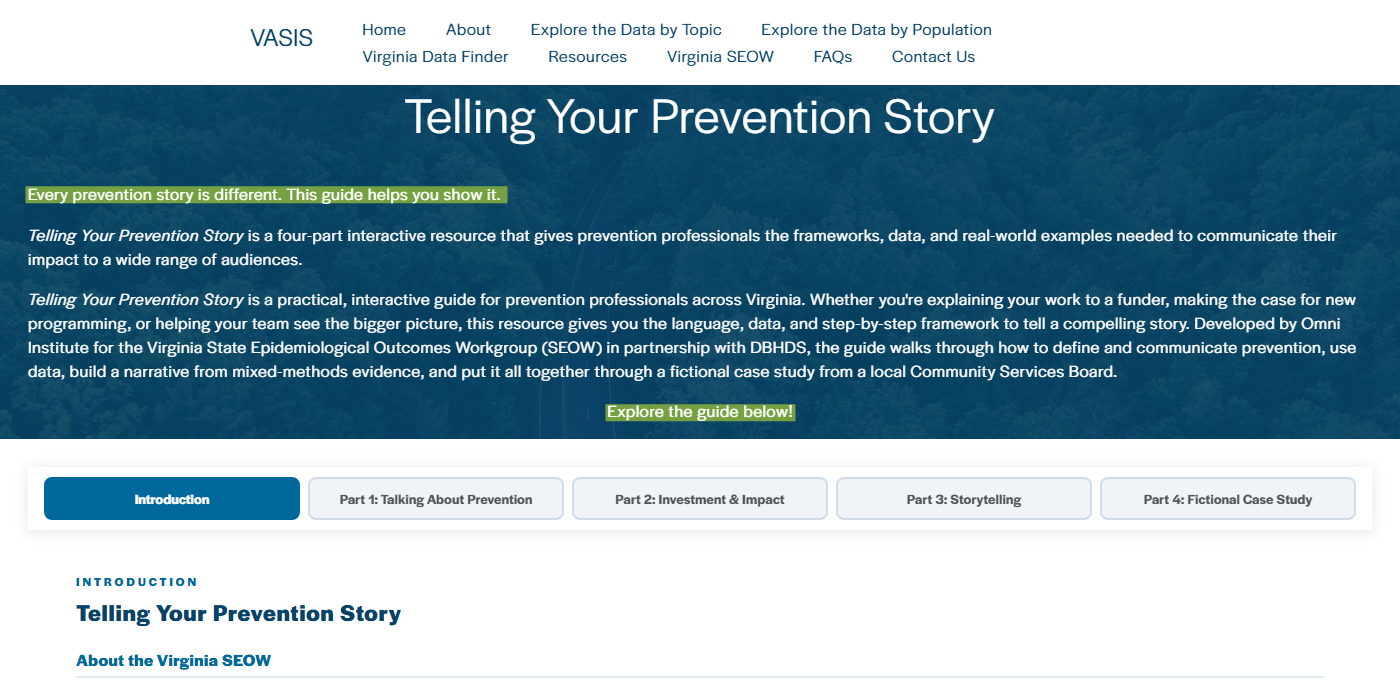
The report is hosted on the Virginia Social Indicator Summary (VASIS) Dashboard website and is organized into four interactive parts:
Explore the Telling Your Prevention Story Guide
Communications Plan
Omni developed a complimentary communications plan for SEOW members to share the report with their networks and integrate it into their own work. It offers guidance for partners on how to promote and distribute the report, including exercises to consider the following:
- Key audiences for sharing the resource.
- Communication strategies (such as websites, newsletters, and social media) with sample language.
- Internal communications with agency leadership, grant managers, and general staff.
- Goals for incorporating the guide into day-to-day work.